Epicyclia Serena O'Neill is a cross between Epicyclia Mabel Kanda and Encyclia cordigera. Encyclia cordigera is a popular Encyclia species that is found in many Encyclia hybrids. It is native is Southern Mexico and Central America. Epicyclia Mabel Kanda is a cross between Encyclia cordigera and Epidendrum densiflorum. Epidendrum densiflorum is native to Ecuardor. So from this information one can tell that Epicyclia Serena O'Neil is about 3/4 Encyclia cordigera. Epicyclia Serena O'Neil likes warm temperatures, but I have never had any problem with leaving it outdoors during the coldest of Miami winters. (never below freezing). It also likes dapples sunlight or high indirect light. I grow mine in a plastic basket filled with tree fern fiber. Encyclias generally like to dry out well between watering and some of them like a winter rest in order to bloom well. However, I have noticed with this particular hybrid that it is important to not deprived this orchid of water during the winter as much as other Encyclias. I have an Encyclia Lee Ward that absolutely will not bloom unless it stays dry all winter long. I always cut back on the watering of the Epicyclia Serena O'Neill during the winter months; however, if I let is dry as much as the Lee Ward, the pseudobulbs shrivel too much, very few new growths will initiate in the spring, and the blooms will be very poor. The lesson is to cut back on water but not completely. I have also found that during its blooming and growth stage that this hybrid likes quite a bit of water, more than many other Encyclia hybrids. Good growing. Enjoy.
Wednesday, May 23, 2012
Tuesday, May 22, 2012
Cattleya purpurata carnea
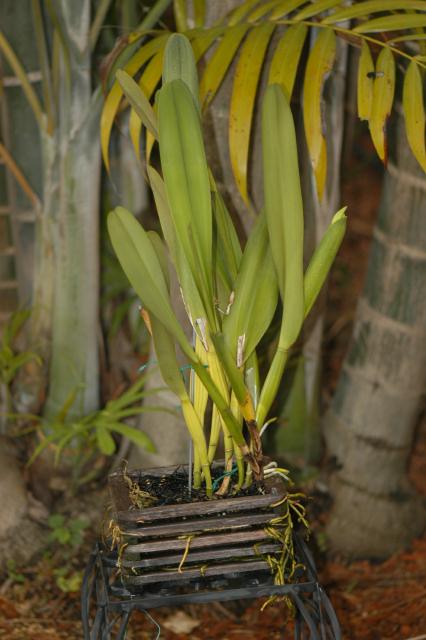
Cattleya purpurata is one of the finest of all cultivated orchids. It has a wide range of colors and many named varieties. It produces large flowers, generally, 6 to 8 inches across. It is used in many Cattleya hybrids. It is native to southern Brazil and is the state flower of Santa Catarina. Those who do not grow orchids are very familiar with pictures of the actual blooms, but many times have never seen an orchid plant up close. Above are pictures of my Cattleya purpurata carnea before it has bloomed. I grow this outdoors under a Cabada Palm. It is mounted inside a wooden basket with tree fern fiber as the media. Cattleya purpurata has tall pseudobulbs and leaves. The pseudobulbs often grow as tall as 20 inches. Notice the pale yellow color of the pseudobulbs and the pale green color of the leaves. This orchid needs plenty of light in order to bloom. I give it as much light as I can without burning the leaves. If it does not get more light than a regular Cattleya it will not bloom. The pale yellow color of the pseudobulbs and the pale green color of the leaves are signs that this plant is getting the right amount of light in order to bloom. This orchid generally blooms in May and June. This picture was taken May 22, 2012 and today is the first day that the buds have started to break out of the sheaths. These pictures are for those who are not familiar with an orchid plant. One can see the green buds just peeking out at the top of the sheaths in these pictures. After this orchid blooms, one should give it a rest with little water. When it starts to grow again, give it plenty of water. Many times these orchids will start new growths in late summer although this particular one has some new pseudobulbs growing now. The growths will be completed in January and February in the United States. The buds will form in the sheaths after a very short rest period and bloom in May or June. Below is the picture of the bloom that this plant had last year in May. It was the first bloom that I had from this cutting. The form was rather poor, but the color is typical of this variety of purpurata. I am hoping for better blooms this year.
Wednesday, February 29, 2012
My Easter Orchid
All last summer I grew,
new green leads, bulbs everywhere.
The fungus attacked,
the sun was a little too hot,
I suffered a few black spots,
and some burnt places as well.
But I continued to grow,
bigger, greener, larger, stronger.
Then all my new bulbs started to show,
to show sheaths, signs of hope, peeping out.
In my sheaths, Creativity rules, and grounds my future.
But the air gets cool and the winter winds are dry.
All my sheaths turn brown and withered.
All I can do is rest.
But as the spring sun warms me up
my sheaths begin to swell, bigger and bigger.
And slowly, green buds split the tops of my sheaths.
Gently and carefully, more and more of my buds appear.
Widening, spreading, and finally opening
to a burst of rose-lavender beauty,
showing the fruit of my hope.
For every observer, please share my joy, my hope,
yes, even my life. May I be your Easter Orchid!
new green leads, bulbs everywhere.
The fungus attacked,
the sun was a little too hot,
I suffered a few black spots,
and some burnt places as well.
But I continued to grow,
bigger, greener, larger, stronger.
Then all my new bulbs started to show,
to show sheaths, signs of hope, peeping out.
In my sheaths, Creativity rules, and grounds my future.
But the air gets cool and the winter winds are dry.
All my sheaths turn brown and withered.
All I can do is rest.
But as the spring sun warms me up
my sheaths begin to swell, bigger and bigger.
And slowly, green buds split the tops of my sheaths.
Gently and carefully, more and more of my buds appear.
Widening, spreading, and finally opening
to a burst of rose-lavender beauty,
showing the fruit of my hope.
For every observer, please share my joy, my hope,
yes, even my life. May I be your Easter Orchid!
Sunday, May 29, 2011
Encyclia tampensis
Encyclia tampensis is an orchid native to Florida. This orchid is also known as the Florida butterfly orchid. It grows mainly in central and southern Florida. It is also native to the Bahamas and Cuba. When the plant gets large, it can have many flower spikes with hundreds of small flowers. It usually blooms in June and July. The pictures below is a bloom on a very small seedling that bloomed for me in May 2011. The color of the blooms vary quite a bit in nature. There is also a white-lipped form of this orchid. It is easy to grow if you can resist watering it too much, especially in the cooler months and early spring. During the growing season, this orchid can take more water, but still likes to dry well between watering.
Wednesday, May 11, 2011
Encyclia Moonlight Shadows
Encyclia Moonlight Shadows is a primary hybrid that is a cross between Encyclia alata and Encyclia cordigera. Most of the Encyclia’s that I have seen have not been very colorful, showy, or fragrant. However, this particular hybrid seems to have more intensity of color than many Encyclias, has a larger bloom than many, and is VERY fragrant. The fragrance of this orchid is its most attractive feature. The fragrance is quite strong in the mornings and is very pleasant. It reminds me most of a very expensive French perfume. This orchid is in bloom on my porch right now. Each morning I am greeted with the wonderful fragrance of its bloom.
Encyclia’s are well known for liking to be grown on the dry side. Some Encyclias like to have a very specific dry spell. However, on this particular one, I water it consistently the same all year round. However, I have it mounted on a plaque of tree fern fiber inside a slatted wooden basket. This type of mount dries out very fast which is what most Encyclias like. However, I have found that some in addition to this type of mount also like a period of almost no water or they will not bloom. This hybrid is not like that. I water this plant nearly every day except during cool periods in the winter. Many growers recommend that this hybrid to be grown in a pot with free draining media. I would say yes to the free draining media, but it is too humid in Miami to grow this in a pot. Growing in a pot will invite fungus and rot. However, as with everything orchids, if you grow it in a pot and it works for you, keep up the good work.
This particular hybrid likes a hot growing temperature. It is ideal for growing in South Florida. It also likes bright, indirect light. It may even take some direct sun, but I do not expose it to direct sun during the brightest part of the South Florida day. I only give it direct sunlight in the morning.
This particular blooming season, this orchid has four flowering spikes with between 8 and 12 blooms on each spike. Enjoy and good orchid growing!
Thursday, February 24, 2011
Guarianthe skinneri coerulea 'Robert' x Guarianthe skinneri alba 'Viva el Jardin'
You may be more familiar with this genus of orchid by the name 'Cattleya'. With all of the switching between genera, this one ended up in 'Guarianthe'. Guarianthe skinneri is the national flower of Costa Rica. It is a beautiful orchid that can have as many as 1,000 blossoms on one plant. Once the flowers open, unfortunately, they do not last very long. Usually, mine has lasted two or three weeks.
This season the blooms on this plant have been the best yet. I cannot find any registration for this cross. However, it is a cross between the cerulean color form and the white form of the plant. (Please don't ask me about the spelling of "coerulea". That is the way it is spelled on the name tag of the plant. I have seen this word spelled several different ways. Probably because most, like me, are not sure of the spelling. But based upon a check on the spelling before I wrote this blog, it seems that the world should be spelled "cerulean".) The flowers seem to be more delicate the most skinneri. The current blooms opened very fast. Last night the buds were just barely beginning to peek open, and this morning I took these pictures. There are still some buds on the plant that will probably open today or tonight. This plant seems to like the 60 degree temperatures that we have had at night during the month of February.
When I bought this plant, it was already mature and in full bloom. Unfortunately, whoever had put the plant in its wooden basket had mounted in with spaghnum moss around the roots. That is a recipe for disaster for someone who grows these plants outdoors without cover. The moss simply holds too much moisture and gets too soggy in our summer rains. For awhile the plant just languished, so I started teasing out all of the moss. I replaced the moss with only a slight amount of long tree fern fiber. The plant began to recover and each season the blooms have gotten better.
During the summer, the plant must be protected from direct sun. It does best with about 30% to 40% of direct South Florida sun. However, in the winter months, the amount of light needs to be increased. These orchids grow in nature on deciduous trees so in nature they get more light during the winter months. More light will result in more blooms and stronger, more upright blossoms. In one of the pictures below, you can see a picture of a single inflorescence that is quite strong and upright with multiple blooms.
Do you have a Guarianthe skinneri? Questions on how to grow it? Send me an email and I will help in any way that I can.
This season the blooms on this plant have been the best yet. I cannot find any registration for this cross. However, it is a cross between the cerulean color form and the white form of the plant. (Please don't ask me about the spelling of "coerulea". That is the way it is spelled on the name tag of the plant. I have seen this word spelled several different ways. Probably because most, like me, are not sure of the spelling. But based upon a check on the spelling before I wrote this blog, it seems that the world should be spelled "cerulean".) The flowers seem to be more delicate the most skinneri. The current blooms opened very fast. Last night the buds were just barely beginning to peek open, and this morning I took these pictures. There are still some buds on the plant that will probably open today or tonight. This plant seems to like the 60 degree temperatures that we have had at night during the month of February.
When I bought this plant, it was already mature and in full bloom. Unfortunately, whoever had put the plant in its wooden basket had mounted in with spaghnum moss around the roots. That is a recipe for disaster for someone who grows these plants outdoors without cover. The moss simply holds too much moisture and gets too soggy in our summer rains. For awhile the plant just languished, so I started teasing out all of the moss. I replaced the moss with only a slight amount of long tree fern fiber. The plant began to recover and each season the blooms have gotten better.
During the summer, the plant must be protected from direct sun. It does best with about 30% to 40% of direct South Florida sun. However, in the winter months, the amount of light needs to be increased. These orchids grow in nature on deciduous trees so in nature they get more light during the winter months. More light will result in more blooms and stronger, more upright blossoms. In one of the pictures below, you can see a picture of a single inflorescence that is quite strong and upright with multiple blooms.
Do you have a Guarianthe skinneri? Questions on how to grow it? Send me an email and I will help in any way that I can.
Monday, February 14, 2011
Lc. Hsin Buu Lady 'YT' Bloom on Valentine's Day 02 14 2011
What a beautiful orchid for Valentine's Day! This plant is a cross between L. anceps and C. Wendy's Valentine. The wonderful shape of this orchid is heavily influenced by the L. anceps species which makes up about 50% of its genetic background. C. Wendy's Valentine is a wonderful hybrid in its own right. The brilliant scarlet color is coming from C. coccinea that makes up part of the genetic background of C. Wendy's Valentine.
This orchid had been very easy to grow and has done very well in the heat of South Florida even though C. coccinea is known for growing on the cooler side of Cattleya culture.
I have one plant in bloom now with two others that have several buds. This plant is still fairly small; however, when it gets larger and more mature, the number of of blooms will increase. Another great feature of this orchid is the strong, upright inforescences that the blooms grow on.
I grow this orchid in a wooden basket. Inside the basket, the orchid is mounted on a tree fern fiber plaque with a few expanded clay pellets around its roots. During the winter, I water every two or three days. But in the very hottest part of our very hot and humid summers in Miami, I water every day EARLY in the day. On DRY, hot days, I water a second time around 10 or 11 AM.
Would you like to know MORE about growing Cattleyas in your own backyard in South Florida? You may email any questions you have to remliw@bellsouth.net. I am glad to help in any way that I can. Have fun and good growing!
This orchid had been very easy to grow and has done very well in the heat of South Florida even though C. coccinea is known for growing on the cooler side of Cattleya culture.
I have one plant in bloom now with two others that have several buds. This plant is still fairly small; however, when it gets larger and more mature, the number of of blooms will increase. Another great feature of this orchid is the strong, upright inforescences that the blooms grow on.
I grow this orchid in a wooden basket. Inside the basket, the orchid is mounted on a tree fern fiber plaque with a few expanded clay pellets around its roots. During the winter, I water every two or three days. But in the very hottest part of our very hot and humid summers in Miami, I water every day EARLY in the day. On DRY, hot days, I water a second time around 10 or 11 AM.
Would you like to know MORE about growing Cattleyas in your own backyard in South Florida? You may email any questions you have to remliw@bellsouth.net. I am glad to help in any way that I can. Have fun and good growing!
Tuesday, January 25, 2011
Rly. Hwa Yuan Bay 'She Shu'
I have written about this hybrid on the blog in the past. However, the photo above is the best bloom that I have had from the plant so far. The plant is now becoming larger and mature. This hybrid has several species in its genetic background: C. dowiana, Bro. sanguinea, C. intermedia, C. warscewiczii, C. tenebrosa, and C. trianae. It is a relatively compact plant and easy to grow in South Florida. Since I grow this outdoors without protection from the rain, it is in a wooden basket without any media at all. This particular hybrid and cultivar has been awarded by the AOS. As the plant grows larger, it can bloom with 20 or more blooms at one time. With this bloom, the plant has seven blooms on three inflorescenses and two buds on another. The color of these blooms is what I like about this orchid the most. The flowers are much smaller than the classic cattleya blooms. The natural spread on the largest of the blooms is just over 9 centimeters. Except for Bro. sanguinea, the size of the blooms is generally smaller than the blooms of the other species in its genetic mix. The blooms have no fragrance. I purchased this hybrid here in South Florida, so it is available in the Miami area. In fact I saw a near specimen size of this hybrid at a local grower just recently.
Have fun. Good growing.
Tuesday, January 4, 2011
Bc. Mililani Star 'Nalo'
I purchased this orchid at the Tamiami Orchid Festival in January 2010. This is its first bloom. The sheaths appeared around July and it took until late December before the blooms started to appear from the sheaths. This is a cross between B. Little Stars and Bc. Morning Glory. It has B. nodosa, B. subulifolia, and C. purpurata in its genetic background. For a first bloom, it has a good number of blooms. This plant promises to be quite floriferous; however, I am dissappointed by its form. I doubt it will be an award winner. However, the color and veining in the blooms are quite nice. A very nice display for January. I have grown this orchid with typical Cattleya culture. I have it mounted on a piece of tree fern fiber that is framed by a wooden raft. It hangs under my Cattleya Pergola most of the year, but when it is getting ready to bloom, I move it to a spot under my peach tree.
Monday, January 3, 2011
Tamiami Orchid Festival
The Tamiami Orchid Festival will be on January 29 and January 30, 2011.
Come join us in Miami at the fairgrounds. Tamiami Orchid Festival is a great
South Florida winter orchid festival!
Come join us in Miami at the fairgrounds. Tamiami Orchid Festival is a great
South Florida winter orchid festival!
Wednesday, December 1, 2010
Bnts. Richard Mueller x Laelia aurea
Do you ever wish that orchids were easier to grow? Well, Bnts. Richard Mueller x Laelia aurea, pictured below in bloom, is very easy to grow and quite floriforeous. This cross can bloom almost any time of the year. Mine is in bloom right now, at the first of December, in Miami, Florida. It has also bloomed this past year twice before this December bloom. It bloomed in early spring and also toward the end of the summer.
This orchid is not unusual, nor does it have great form or even a very remarkable color; but, nevertheless, it is attractive. Its best quality is it is EASY to grow and EASY to bloom. I have this orchid outdoors all year round in Miami. Last winter, the temperature dropped to 34 F and this plant did not suffer at all. It was outdoors all summer long when the humidity reached nearly 100% and the temp topped out over 100 F. It survived this great variation without even the smallest problem. While I doubt that it could survive temperatures below freezing or in an extremely dry environment or in a high shade environment, it still thrives in quite variable conditions.
How do I grow it? This plant is growing mounted on a round piece of rough cut cedar and it is hung in the horizontal position. I screwed four eyes into the cedar and hung it with a wire basket hanger. I have been told in the past that one should NOT hang orchids on mounts in the horizontal position. Well, if someone tells me that I shouldn't do something and I cannot see any reason for the prohibition, then I will probably try it anyway. Especially, when the possible consequences are minor. This plant probably costs around $10 as a seedling and maybe not much more even full grown. A small price to pay for orchid education. Back to the mount. The orchid just loves it on this cedar mount. In just three months after mounting, the roots had spread all over the surface of the mount and even now continues to fill in all the area on the surface.
I grow this plant in about 50% shade, water daily in the driest and hottest part of the year, and use a weak solution of fertilizer about once a week. I have never had any pest or fungus problems with this plant.
Do you have an orchid that is easy to grow? Leave me a comment about your plant and how you care for it!
Have fun and good growing.
This orchid is not unusual, nor does it have great form or even a very remarkable color; but, nevertheless, it is attractive. Its best quality is it is EASY to grow and EASY to bloom. I have this orchid outdoors all year round in Miami. Last winter, the temperature dropped to 34 F and this plant did not suffer at all. It was outdoors all summer long when the humidity reached nearly 100% and the temp topped out over 100 F. It survived this great variation without even the smallest problem. While I doubt that it could survive temperatures below freezing or in an extremely dry environment or in a high shade environment, it still thrives in quite variable conditions.
How do I grow it? This plant is growing mounted on a round piece of rough cut cedar and it is hung in the horizontal position. I screwed four eyes into the cedar and hung it with a wire basket hanger. I have been told in the past that one should NOT hang orchids on mounts in the horizontal position. Well, if someone tells me that I shouldn't do something and I cannot see any reason for the prohibition, then I will probably try it anyway. Especially, when the possible consequences are minor. This plant probably costs around $10 as a seedling and maybe not much more even full grown. A small price to pay for orchid education. Back to the mount. The orchid just loves it on this cedar mount. In just three months after mounting, the roots had spread all over the surface of the mount and even now continues to fill in all the area on the surface.
I grow this plant in about 50% shade, water daily in the driest and hottest part of the year, and use a weak solution of fertilizer about once a week. I have never had any pest or fungus problems with this plant.
Do you have an orchid that is easy to grow? Leave me a comment about your plant and how you care for it!
Have fun and good growing.
Wednesday, October 27, 2010
Rlc. Yen Corona 'Green Genie'
I woke up this morning and this new bloom greeted me in my garden. It is a Cattleya hybrid that has quite a few different species in its background. C. bicolor is one of the species that makes up this beautiful flower. I suspect that the green sepals are coming from C. bicolor. These photographs have been taken with various types of light and various backgrounds. I am a totally amateur photographer, but I enjoy it and enjoy trying out various methods for taking a photo of the same subject. Which photo do YOU like best?
Sunday, October 24, 2010
Ascocenda Princess Mikasa 'Indigo'
This orchid is a cross between Vanda coerulea and Ascocenda Royal Sapphire. The pictures below are from two plants that I bought a year go as seedlings. They are still only about 7 inches tall. Based upon this early first bloom, these plants promise to be very floriferous. The color is a brillant, electric blue. Since these blooms are the first for these plants, the flower spikes are SHORT, and they do not have very many flowers. However, as these plants get larger, they promise to have many more blooms and longer flower spikes.
This orchid seems to enjoy the South Florida environment. It seems to be tolerant of a fairly wide range of temperatures. It is generally recommended that this orchid grow in cool to intermediate temperatures. This would mean that night temperatures should be between 50 and 60 F. South Florida may get some of these kind of nights during the winter but most of the time the night time temperatures are going to be much warmer. These plants went through the hottest part of the summer without any problem. Some recommend that these plants receive full sun. However, here in South Florida, I have been giving them only about 50% of full sun, and they seem to be doing fine.
In addition to having a brillant color and being an early bloomer, the flowers are very well shaped. They are very flat with no gaps between the petals and sepals. If you live in South Florida, I would highly recommend getting one of these orchids for the color alone.
They are BEAUTIFUL.
This orchid seems to enjoy the South Florida environment. It seems to be tolerant of a fairly wide range of temperatures. It is generally recommended that this orchid grow in cool to intermediate temperatures. This would mean that night temperatures should be between 50 and 60 F. South Florida may get some of these kind of nights during the winter but most of the time the night time temperatures are going to be much warmer. These plants went through the hottest part of the summer without any problem. Some recommend that these plants receive full sun. However, here in South Florida, I have been giving them only about 50% of full sun, and they seem to be doing fine.
In addition to having a brillant color and being an early bloomer, the flowers are very well shaped. They are very flat with no gaps between the petals and sepals. If you live in South Florida, I would highly recommend getting one of these orchids for the color alone.
They are BEAUTIFUL.
Thursday, October 14, 2010
Guaricattonia Starrlyn 'Kate'
I bought this orchid as a seedling two or three years ago. I think it needs a little more light to bloom well. It also probably prefers a little cooler weather than we have here in Miami, FL. In spite of these two problems, the plant has bloomed for me.
Guaricattonia Starrlyn 'Kate' is a hybrid that is a small plant with small flowers. This makes it an easy plant to have for a backyard grower. It does not take up much room and it is easy to move around. When this one bloomed I moved it into my family room. I normally hangs in a basket under my peach tree or under my Cattleya Pergola. This plant takes fairly standard Cattleya culture with maybe a little higher light. For someone growing it in South Florida, make sure that it drys out quickly. If you have no cover from the rain, you may want to put it into a wooden basket with little or NO media. During dry, hot spells you may need to water more often with this set up but you will save the plant from certain death by root rot.
Guaricatonia Starrlyn 'Kate' is a cross between Cattleytonia Capri and Guaritonia Why Not. The species that are in this hybrid's background are Broughtonia sanguinea, Guarianthe aurantiaca, Cattleya intermedia, and Cattleya bicolor.
Guaricattonia Starrlyn 'Kate' is a hybrid that is a small plant with small flowers. This makes it an easy plant to have for a backyard grower. It does not take up much room and it is easy to move around. When this one bloomed I moved it into my family room. I normally hangs in a basket under my peach tree or under my Cattleya Pergola. This plant takes fairly standard Cattleya culture with maybe a little higher light. For someone growing it in South Florida, make sure that it drys out quickly. If you have no cover from the rain, you may want to put it into a wooden basket with little or NO media. During dry, hot spells you may need to water more often with this set up but you will save the plant from certain death by root rot.
Guaricatonia Starrlyn 'Kate' is a cross between Cattleytonia Capri and Guaritonia Why Not. The species that are in this hybrid's background are Broughtonia sanguinea, Guarianthe aurantiaca, Cattleya intermedia, and Cattleya bicolor.
Thursday, October 7, 2010
Mokara Moonlight 'Tangerine' at SFOS Speaker's Day AOS Award HCC 78 points
South Florida Orchid Society had its annual speaker's day on October 3, 2010. This year they had five speakers: Gene Crocker from Carter & Holmes, Dr. Wagner Vendrame from the University of Florida, Eric Christensen, a taxonomist, George Carr, and Peter Lin, a hybridizer of Phals. There were also plant sales and a raffle.
They also had AOS judging and panel discussions regarding plants that participants brought. I brought Mokara Moonlight 'Tangerine' which won HCC. The plant had 39 flowers and three buds well displayed on two upright inflorescences. The sepals and petals were very light green, heavily overlaid with golden orange. The lip was a darker orange and the anther caps were brown. The flowers had a firm substance and the texture was slightly crystalline.
Mokara's are grown just like Vanda's, but they generally like even more sunlight. Many growers report that they can grow a Mokara in full sun, although I protect mine from noon day sun because the intensity of sunlight in South Florida can reach 10,000 footcandles. Mine grows in a clay pot set inside a wooden, slatted basket WITHOUT any media. It is staked with thick, galvinized wire. With enough sun this plant blooms two or three times throughout the summer months. It nearly always blooms with two flower spikes with spikes that are very upright even without any staking.
Do you have a question about growing vandaceous orchids in South Florida? Ask your question with a comment and I will help in any way that I can.
Enjoy and good growing!
They also had AOS judging and panel discussions regarding plants that participants brought. I brought Mokara Moonlight 'Tangerine' which won HCC. The plant had 39 flowers and three buds well displayed on two upright inflorescences. The sepals and petals were very light green, heavily overlaid with golden orange. The lip was a darker orange and the anther caps were brown. The flowers had a firm substance and the texture was slightly crystalline.
Mokara's are grown just like Vanda's, but they generally like even more sunlight. Many growers report that they can grow a Mokara in full sun, although I protect mine from noon day sun because the intensity of sunlight in South Florida can reach 10,000 footcandles. Mine grows in a clay pot set inside a wooden, slatted basket WITHOUT any media. It is staked with thick, galvinized wire. With enough sun this plant blooms two or three times throughout the summer months. It nearly always blooms with two flower spikes with spikes that are very upright even without any staking.
Do you have a question about growing vandaceous orchids in South Florida? Ask your question with a comment and I will help in any way that I can.
Enjoy and good growing!
Thursday, September 30, 2010
Oncidium Gower Ramsey 'Volcano Queen'
I have not had great luck with growing this orchid. It has been a couple of years since this one has bloomed last. I think it was not getting quite enough light. I also think it is a little too HOT in South Florida for this orchid. While there are some hot growing orchids in its genetic background, there are also some that like intermediate temperatures and at least one that likes cooler temperatures. The leaves on this orchid are very thin and mine tends to droop and curl up a little. This is generally a sign of not quite enough water, but with the heat in South Florida it is hard to give it enough water and not rot the roots at the same time.
Despite the problems, it has started to bloom right at the end of September 2010. It currently has six spikes and could have up to 70 or 80 blooms per spike. Right now only the first spike has fully opened blooms, although there are some buds on this first spike to open yet. I am hoping that by mid October all of the blooms will have opened.
Do you have experience with growing this orchid in South Florida? If so, leave a comment on how you care for it. Thanks and enjoy.
Friday, September 17, 2010
SFOS Silver Medal and AOS Award of Merit - Ascocenda Banjong Delight 'Prince Harry' AM/AOS
I have owned this plant for four years and this is its first award. It is hard to get all of the buds to open. Many times the buds on the top third of the inflorescence will fail. Not sure why. Not thrips because I spray for those. Maybe too dry. I have made very sure this past year to give it plenty of water, especially in March, April, and the first half of May. Maybe the gas powered lawnmower was polluting the bloom with its exhaust. This past year I have banned the gas powered lawnmower from my growing area. I only use electric powered equipment. This plant also requires plenty of light and lots of fertilizer. The color is gorgeous. The flowers glisten in the sunlight.
While I have won Blue Ribbons before, this is my first AOS award. The cultivar was named after my cat, Prince Harry.
Monday, September 13, 2010
Seedling from Home Depot
Four years ago I purchased an orchid seedling from Home Depot in a small plastic bag. I had no idea what I was buying. It was inexpensive, and I thought it would be a easy way to experiment with growing an orchid.
Four years later, the plant has finally had a bloom. The orchid is Brassocatanthe Little Marmaid 'Janet' BM/JOGA. Some people claim that there was a misspelling when the name was registered, and its name should be "Little Mermaid". That makes more sense; however, from everything that I can tell, it was registered as "Little Marmaid". It is a cross between Brassanthe Maikai 'Mayumi' x Cattleya walkeriana. I have two flowers on one spike. As the plant gets more mature, I am hoping for up to four flowers one one or more spikes at each bloom. I am also hoping for flowers that are a little larger, but they will never be very large. It was expected that the flower would be small. Probably why it was named "Little Marmaid".
The lip on this particular bloom is remarkable in that it has a very distinct margin between the creamy yellow center and the lavender color around the edge of the lip. Now, I have seen pictures of other blooms from this plant that have this distinct margin; however, this bloom has an additional feature that, combined with the distinct margin, makes it remarkable. Along with this distinct margin, the lip also has distinct waterfall splashes of dark purple on a lighter lavender background. On other examples of this orchid, sometimes these splashes of purple are lighter and they merge into the yellow center without a distinct margin. On other examples that have distinct margins, the splashes of purple have been either non-existent or were not very distinct, having a more muddled appearance. The lip on this bloom really makes the flower stand out. Hopefully this feature will continue to express itself on future blooms.
Four years later, the plant has finally had a bloom. The orchid is Brassocatanthe Little Marmaid 'Janet' BM/JOGA. Some people claim that there was a misspelling when the name was registered, and its name should be "Little Mermaid". That makes more sense; however, from everything that I can tell, it was registered as "Little Marmaid". It is a cross between Brassanthe Maikai 'Mayumi' x Cattleya walkeriana. I have two flowers on one spike. As the plant gets more mature, I am hoping for up to four flowers one one or more spikes at each bloom. I am also hoping for flowers that are a little larger, but they will never be very large. It was expected that the flower would be small. Probably why it was named "Little Marmaid".
The lip on this particular bloom is remarkable in that it has a very distinct margin between the creamy yellow center and the lavender color around the edge of the lip. Now, I have seen pictures of other blooms from this plant that have this distinct margin; however, this bloom has an additional feature that, combined with the distinct margin, makes it remarkable. Along with this distinct margin, the lip also has distinct waterfall splashes of dark purple on a lighter lavender background. On other examples of this orchid, sometimes these splashes of purple are lighter and they merge into the yellow center without a distinct margin. On other examples that have distinct margins, the splashes of purple have been either non-existent or were not very distinct, having a more muddled appearance. The lip on this bloom really makes the flower stand out. Hopefully this feature will continue to express itself on future blooms.
I grow this orchid completely bare-rooted in a slatted, wooden basket.
Wednesday, September 8, 2010
Ascocenda Crownfox Butterfly - September 2010
This orchid gets high marks for its clear colors, distinct markings and very flat flowers. The size of the bloom is near the limit of this hybrid, about 7.5 cm. 8 cm. has been recorded on other cultivars of this hybrid.
This is the first bloom for this plant, even though the plant is quite a good size. The arrangement of the flowers and the spacing seems to be very poor. Maybe it is because this is the first bloom.
Blc, Alma Kee 'Tipmalee' - September 8, 2010
My Blc. Alma Kee 'Tipmalee' has one of its blooms nearly open. The picture is below. It has no fragrance, but the bloom has the characteristic clear yellow color on its sepals and petals. The lip has the deep purple color. The plant has great color. So far the flower is not completely open, so it is hard to tell about its shape. Although, it does appear to have a fairly round shape. It does not seem to have a very large bloom. The plant has another spike with three buds that have not opened yet.
Subscribe to:
Posts (Atom)
.jpg)
.jpg)